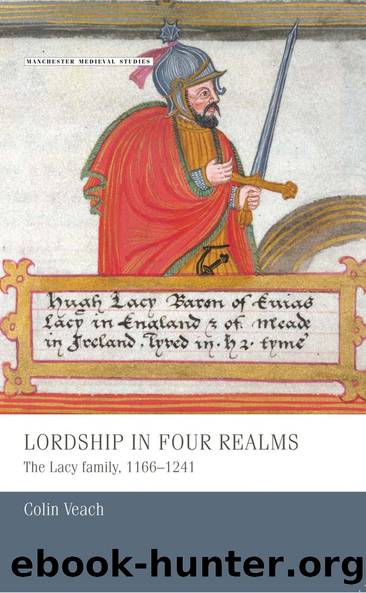
Lordship in four realms by Colin Veach
Author:Colin Veach [Veach, Colin]
Language: eng
Format: epub
Tags: Nonfiction, History, Medieval
ISBN: 9781526103086
Publisher: Manchester University Press
Published: 2015-11-01T04:00:00+00:00
Conclusion
In the early days of the English invasion of Ireland, King Henry II had sought to control his new volatile territory by more or less emulating the practice of the early Norman kings regarding Wales. Lacking the resources to mount a thorough conquest of Ireland, Henry had allowed new imports from the Welsh march (such as Strongbow and Hugh de Lacy) something approaching marcher liberties in Ireland. In Ireland, as in Wales, these lords had been granted a great deal of control over their frontier territories in order to support their lordship in a hostile and ethnically mixed realm. However, John, as lord of Ireland, sought to revoke the independent character of colonial lordship in Ireland. Some of Johnâs first grants as lord of Ireland in 1185 reserved the Crown pleas and ecclesiastical investiture, with a standard clause inserted into grants from about 1199. This was the year of Johnâs coronation in England, which (as seen in Chapter 4) rendered Ireland peripheral to Johnâs plans for some time. However, despite being forced to work with the Lacys and Briouzes to achieve his ends in Ireland and Wales, John nevertheless tried to undermine their lordship in Ireland by allowing at least two pleas relating to Meath to be heard in the royal court at Dublin.
The loss of Normandy in 1204 had a profound effect on the Plantagenet empire, as âten furious yearsâ saw John use every means at his disposal to extract more and more money from his English subjects to fund the reconquest of his continental inheritance. It was this abuse of royal lordship (of which the English already had wearisome experience in the reigns of Henry II and Richard) that ultimately led to the English baronsâ rebellion and Magna Carta in 1215. In England, therefore, it was the abuse of royal lordship not its prevalence which was at issue; the baronial reformers (who, as will be seen in Chapter 6, eventually included Walter de Lacy and his fellow royalists, who together reissued Magna Carta in Henry IIIâs name) merely sought to standardise its application. A well-regulated royal administration, including swift recourse to the royal courts when needed, was a welcome addition to the relatively peaceful, and increasingly litigious, society in England. Ireland was a different matter. Although the entire island theoretically constituted a regnum, over all of which John claimed lordship, Ireland was socially and politically fragmented. Johnâs attempts to replicate English royal lordship in Ireland ignored the realities of frontier life, and set his Irish justiciar against the colonyâs most powerful lords.
The collision between royal and aristocratic lordship, first felt in Munster in the winter of 1206â7, sent shockwaves through Ireland. Johnâs initiatives disturbed and galvanised the settler community, and in 1207 there was a violent reaction against Meiler fitz Henryâs justiciarship. The new intrusiveness of royal lordship lay at the root of matters, with prerogative lordship intruding Crown administrators into Meath and Leinster, and threatening the very existence of the honor of Limerick. It was explicitly excluded
Download
This site does not store any files on its server. We only index and link to content provided by other sites. Please contact the content providers to delete copyright contents if any and email us, we'll remove relevant links or contents immediately.
| Belgium | France |
| Germany | Great Britain |
| Greenland | Italy |
| Netherlands | Romania |
| Scandinavia |
Room 212 by Kate Stewart(5136)
The Crown by Robert Lacey(4825)
Endurance: Shackleton's Incredible Voyage by Alfred Lansing(4792)
The Iron Duke by The Iron Duke(4370)
The Rape of Nanking by Iris Chang(4228)
Joan of Arc by Mary Gordon(4122)
Killing England by Bill O'Reilly(4015)
Say Nothing by Patrick Radden Keefe(3994)
I'll Give You the Sun by Jandy Nelson(3455)
Shadow of Night by Deborah Harkness(3382)
Hitler's Monsters by Eric Kurlander(3355)
Mary, Queen of Scots, and the Murder of Lord Darnley by Alison Weir(3220)
Blood and Sand by Alex Von Tunzelmann(3210)
Eleanor & Park by Rainbow Rowell(3191)
Darkest Hour by Anthony McCarten(3138)
Margaret Thatcher: The Autobiography by Thatcher Margaret(3090)
Book of Life by Deborah Harkness(2947)
Red Famine: Stalin's War on Ukraine by Anne Applebaum(2943)
The One Memory of Flora Banks by Emily Barr(2872)
